
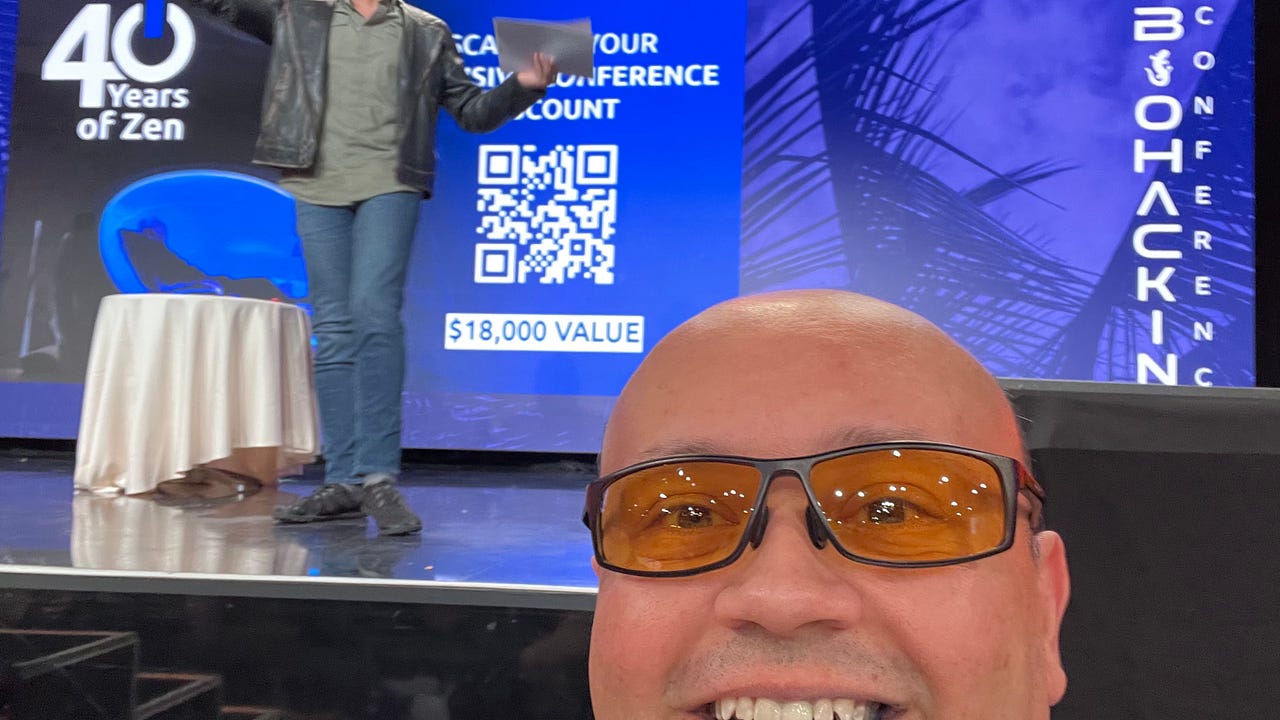
8th Annual Biohacking Conference Recap: Be Dangerous, Jim Kwik's Brain Stack, and the Four F's
The 8th Annual Biohacking Conference took place in Beverly Hills, California — keynotes and lunches held in the International Ballroom of the Beverly Hilton, the same room where the Golden Globes are awarded. It was an appropriately grand setting for what turned out to be one of the most content-rich biohacking events yet.
Dave Asprey: Be Dangerous
Dave opened the conference with a challenge: be dangerous. Not dangerous in the sense of recklessness, but dangerous in the sense of having the courage, discipline, and self-awareness to live differently from the default. His five traits of a dangerous person:
- Do the right thing, even when it's hard.
- Be peaceful and kind, even when others aren't.
- Make decisions based on data, not emotions.
- Take calculated risks when it's worth it.
- Push yourself outside your comfort zone.
This framing has become a central theme of the biohacking movement Dave leads — the idea that personal optimization is inherently a countercultural act, requiring the willingness to question default programming and take responsibility for your own biology.
Charlie Engle: The Power of the Human Spirit
Charlie Engle is an ultramarathon runner, author, and motivational speaker with one of the most remarkable comeback stories in the endurance world. He ran the Sahara Desert — the equivalent of two marathons every day for 111 consecutive days — which became the documentary Running the Sahara. But what makes Charlie's story powerful isn't just the athletic achievement: it's the arc from addiction and federal prison to becoming a living demonstration of what the human spirit can do when it stops running from itself and starts running toward something.
Jim Kwik: The Brain Supplement Stack
Jim Kwik appeared at this conference with something he'd never shared publicly before: the specific supplements he takes to support brain health. Given that his entire professional life is built on memory and cognitive performance, the list is worth paying attention to:
Omega-3 fatty acids — Support proper blood flow in the brain, cognitive performance, and memory. The brain is approximately 60% fat, and omega-3s are essential structural components.
Huperzine A — Inhibits acetylcholinesterase, the enzyme that breaks down acetylcholine, thereby maintaining higher choline levels. Acetylcholine is the primary neurotransmitter involved in learning and memory.
Phosphatidylserine (Serinaid) — Supports the structure of brain cell membranes and is one of the more well-researched supplements for cognitive health, attention, verbal fluency, and age-related memory challenges.
Bacopa Monnieri (Synapsa) — An adaptogenic herb with clinical research supporting improvements in decision-making speed, information processing in multitasking environments, and retention of new information.
Alpha GPC — A choline precursor that crosses the blood-brain barrier and supports cognitive function, memory, attention, and learning.
DMAE (dimethylaminoethanol) — Supports cognitive function and energy levels, and is involved in the synthesis of choline, which supports dopamine and serotonin production.
As Jim says: "If you only do easy things in life, life gets hard."
Dr. Mercola's Prescription
I spotted Dr. Mercola walking through the tech hall before his keynote and introduced myself. He immediately grabbed my arm, put his deeply tanned forearm next to mine, and pointed out the difference in sun exposure. His single highest-priority recommendation: work up to one hour of sun exposure daily, ideally during solar noon.
His full list of core recommendations has remained consistent across conferences: optimize vitamin D (target 60–80 ng/ml), manage iron levels and donate blood if they're high, minimize linoleic acid (the omega-6 fat found in seed oils, chicken, pork, and most restaurant sauces), practice time-restricted eating, and prioritize resistance training as you age.
The VIP Dinner and a Conversation with Dave
The VIP dinner was held at Sant'olina, a rooftop restaurant with panoramic views of Beverly Hills. Dave was making rounds, and I had a brief moment with him — my goal was to thank him for the gift of 40 Years of Zen, the advanced neurofeedback program I'd won at the previous year's virtual conference. Trying not to get emotional, I told him what the experience meant to me. We had a good hug.
Dr. Patrick Porter, creator of BrainTap, was also at the dinner — an appropriate setting for a conversation about light-and-sound-assisted neurological state changes.
The Four F's
Dave dedicated time to explaining what he calls the Four F's — the four primal biological drives that govern what he calls our MeatOS:
Fear — Evolutionary survival programming. Our ancestors who passed on their genes were the best at identifying and responding to threats. Fear is the first and most powerful drive.
Food — Once immediate survival is handled, the next drive is caloric acquisition. We're wired to eat as much as possible because our ancestors faced regular scarcity. This wiring hasn't updated to match modern food abundance.
Fertility — After survival and food, procreation is the biological priority. This drive shapes enormous amounts of human behavior.
Friendship — Community and cooperation. Only when the first three F's are satisfied can this drive be fully expressed. The conference itself is a living example of what happens when people with shared values come together around something meaningful.
What's Next
There's more to explore from the Tech Hall — Rapid Release Therapy, BrainTap, Apollo Neuro, Xero Shoes, HypoAir, EnergyBits, and more — all will get their own treatment in future writing. The 9th Annual Biohacking Conference is already scheduled for June 22–24, 2023, in Orlando, Florida.
For upcoming biohacking and wellness conferences, explore the Health Conference Directory.